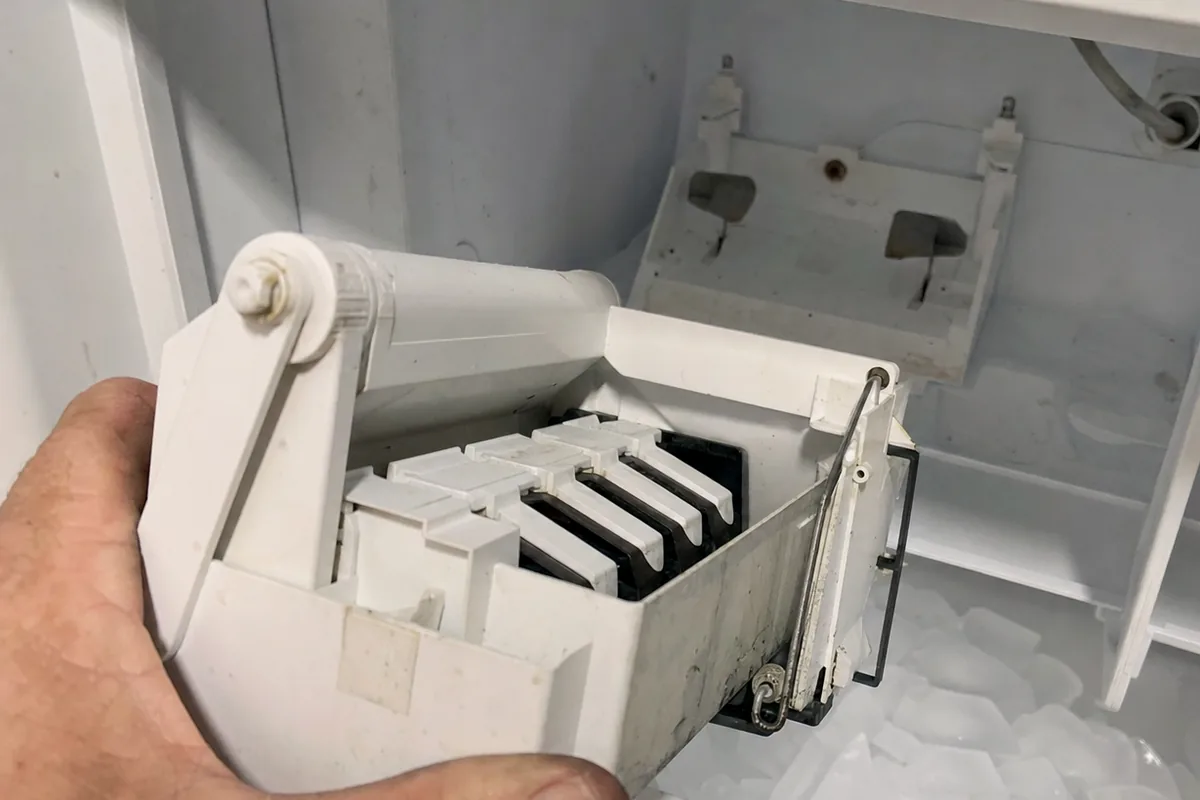
An ice machine is one of the few appliances in a house that runs a repeatable sequence you can watch from beginning to end. It fills a mould with a measured amount of water, freezes it, warms the mould just enough to release the ice, and drains what it does not use. Four steps, in order, on a timer.
That structure is a gift to diagnosis. Almost every complaint we are called about belongs to exactly one of the four, and an owner who can say which one has gone wrong has done a genuinely useful part of the work before we arrive.
Fill
The valve opens for a fixed interval and the control assumes a fixed volume arrives. Nothing in that arrangement measures what actually went in. So anything that reduces flow — a partly closed shut-off behind the cabinet, a kinked supply line, a filter that has been in place for years, a valve that is not opening fully — produces the same result: a mould that is short of water, and cubes that come out thin, hollow or half formed.
This is the fault where the intuitive correction makes matters worse. A poor cube reads as a freezing problem, so the control goes colder. The cube then freezes harder, the harvest takes longer, and the machine makes less ice than it did before.
Freeze
A freeze that is genuinely too slow is usually not a freeze problem at all. It is a heat-rejection problem: a condenser that cannot pass air, because the grille is blocked, the fins are matted, or in an undercounter installation the toe-kick vent has been closed by a later plinth or a run of new flooring. An ice machine works harder for its output than anything else in the kitchen, and it is the first appliance to complain when its air path narrows.
Harvest
Harvest is the moment the ice lets go. A small heater warms the mould just enough to release the cube, and the cycle is timed around how long that should take. Anything that comes between the heater and the ice — a film on the mould, a deposit built up over years — stretches that step. The machine spends more of the day running to produce less, and the compressor and the harvest heater both age faster for it.
A machine that fills and never harvests is the clearest version of this, and it is worth reporting in exactly those words. It points at a short list.
Drain
The step nobody thinks about. A gravity drain that has silted up backs water into the bin, where it refreezes as a sheet and takes the chute — or, in a bin machine, the auger — with it. Standing water under the unit is the same story on the floor, and on a lanai installation it will find the cabinetry as well.
Drain faults are also where taste complaints originate. Ice that tastes of the drain rather than of the water is telling you the trap or the line is not clearing. That is a cleaning and plumbing job, not a refrigeration one, and we would rather say so than sell a part.
The order we check them in
Air path first, because it is the cheapest to correct and it produces symptoms in all four steps. Then fill volume across a complete cycle, because it is measurable and it explains most cube complaints. Then harvest time, timed rather than estimated. Then the drain, which is usually obvious once the first three are known good.
Working in that order matters. Any of these faults can be made to look like a failing sealed system if you start at the expensive end and work backwards.
What is worth telling us when you book
Whether the machine fills at all. Whether it fills and never releases. Whether the cubes are thin, cloudy or fused into a sheet. Whether there is water on the floor. Whether the unit is indoors or on a lanai, and whether it is plumbed to a filter. Each of those changes what rides in the van, and several of them change whether the visit needs a plumber rather than us.
The honest limit
Some ice machines reach a point where the sensible advice is not a repair. A bin machine with a failed auger assembly and a tired sealed system in the same visit is a replacement conversation, and an outdoor unit that has spent a decade in salt air may be past the point where new parts stay new. We will say which we think it is, and we would rather lose the work than sell the first of three repairs.