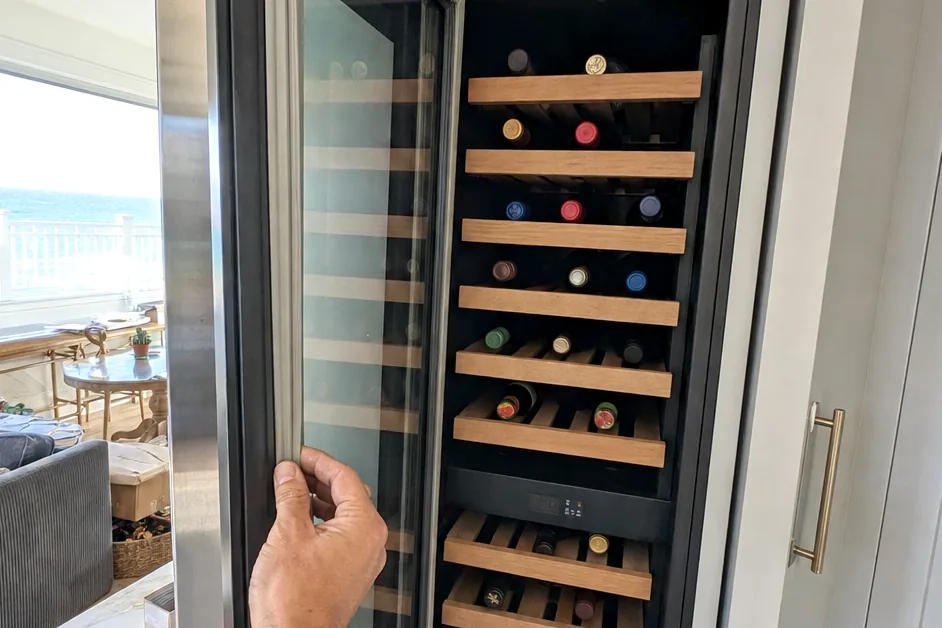
An integrated column is a refrigerator, or a freezer, built to disappear. The door takes a panel matched to the surrounding cabinetry, the unit sits flush with the face of the run, and the grille is hidden behind a trim piece rather than presented at the plinth. Kitchens in Palencia, at King & Bear and through the newer SilverLeaf houses are full of them, usually in pairs — a refrigerator column and a freezer column standing side by side, sharing a common face and absolutely nothing else.
The pair is not one appliance
Owners reasonably describe a matched pair as though it were a single machine, and it is worth saying plainly that it is not. Two columns are two cabinets, two sealed systems, two control boards and two sets of hinges. When the freezer column drifts and the refrigerator column beside it is perfect, nothing has gone wrong with “the refrigerator” — one of two independent machines needs attention, and the other should be left alone.
This matters for the estimate as much as for the diagnosis. A fault confined to one column is a repair to one column.
Alignment is a real fault, not a cosmetic one
The panel is the part of the appliance the household looks at every day, and a door that has settled a few millimetres out of line reads as a carpentry complaint. It is usually not. A custom panel is heavy, and its weight sits at the far end of a lever from the hinge. Over years the hinge takes a set, the door hangs a fraction low, and it no longer pulls itself the last of the way closed.
At that point you have a sealing problem wearing the costume of an alignment problem. Warm room air enters at the top corner, the evaporator answers with frost, the column runs longer than it should, and the first thing anyone actually notices is that the ice cream has gone soft. Correcting the hinge and resetting the panel is often the whole repair.
Where the heat goes
The other difference between a column and a conventional built-in is the air path. Flush installation puts the intake and the discharge behind trim, and a cabinetmaker who was not on site when the appliance specification was written can close that path with the best of intentions. We have opened toe-kick trim to find a solid backing board where an air gap belonged, and a column that had been running twenty per cent longer than its twin for years as a result.
The symptom of a restricted air path is rarely dramatic. It is a hum that was not there before, a grille that is warm to the back of the hand, and a compressor that no longer cycles off overnight. All three are worth a call before they turn into a sealed-system repair.
Getting behind a flush-fitted column
A column that sits flush is a column that has to come forward for some repairs, and that is a planned operation rather than an improvisation. The custom panel usually comes off first; the unit is anchored to the surrounding cabinetry at the top and stands on levelling feet or rollers at the rear; a plumbed column has a supply line and a shut-off behind it that somebody fitted years ago and nobody has touched since. Stone floors and a tight island run leave very little margin either side.
None of that is difficult when it is known in advance. All of it is a problem when it is discovered on the day. Before the visit it helps to know whether the panels are removable, where the water shut-off is, and what the floor is — three answers that between them decide whether a repair finishes in one appointment.
Parts are keyed to the production run
Hinge hardware, gasket profiles, evaporator assemblies and control boards changed across the years these kitchens were built, and a great deal of what goes into a column is specific to a production run rather than to a model name. We take the serial number from the rating plate before anything is ordered, because a part identified from a photograph of the front of the appliance is a part that comes back a second time. Some components are stocked and arrive quickly; others are ordered in, and the written estimate names the wait as well as the price.
Booking
A visit is a flat $80 diagnostic, credited toward the repair when you approve it. There is a written estimate before any part is ordered. Parts are genuine OEM, and finished work carries 90 days on labour and 365 days on parts. Weekdays 8:00 am to 6:00 pm, Saturday 9:00 am to 4:00 pm.
Old City Cold Storage Co. is an independent shop. We service Sub-Zero refrigeration only, and we hold no appointment from the manufacturer.